

How To Repair Porsche 944 S2 Cabriolet Top
| Porsche 944 | |
|---|---|
 1986 944 Turbo (951) US-spec | |
| Overview | |
| Manufacturer | Porsche AG |
| Production | 1982–1991 |
| Assembly | Federal republic of germany: Neckarsulm, Stuttgart |
| Designer | Harm Lagaay (Porsche AG) |
| Body and chassis | |
| Class | Sports auto (S) |
| Body style |
|
| Layout | Front mid-engine, rear-wheel-bulldoze |
| Related | Porsche 924 |
| Powertrain | |
| Engine |
|
| Manual |
|
| Dimensions | |
| Wheelbase | 2,400 mm (94.5 in) |
| Length |
|
| Width | one,735 mm (68.3 in) |
| Height | 1,275 mm (fifty.2 in) |
| Adjourn weight |
|
| Chronology | |
| Successor | Porsche 968 |
The Porsche 944 is a sports car manufactured by High german car manufacturer Porsche from 1982 until 1991. A forepart-engine, rear-wheel drive mid-level model based on the 924 platform, the 944 was bachelor in coupé or cabriolet body styles, with either naturally aspirated or turbocharged engines. With over 163,000 cars produced, the 944 was the about successful sports machine in Porsche'southward history until the introductions of the Boxster and 997 Carrera.
Extensive design revisions for the 1992 model year prompted Porsche to drib the 944 nameplate and rebrand the vehicle as the 968.
History [edit]


The 924 GTP LeMans served as the basis for the mid-level 944
The 924 had originally been a projection of VW-Porsche, a articulation Porsche/Volkswagen company incorporated to develop and produce the 914 which was sold in Europe badged as both a Porsche and a Volkswagen. In 1972, a replacement for the Volkswagen version of the 914, code named EA-425 began development. The model was to exist sold as an Audi as part of the VW-Audi-Porsche marketing arrangement. Porsche was to manufacture its ain version of the car.[1] At one betoken, Volkswagen head Rudolf Leidig declared the EX-425 was going to be a Volkswagen exclusively, thus denying Porsche's version of the 914'due south replacement. Although testing had begun in the Spring of 1974, Volkswagen cancelled the EX-425 program, the reason existence significant financial losses due to declining sales and rising development costs for new vehicles too every bit the difference of Leidig. The recently introduced Volkswagen Scirocco was expected to fill the sports coupé market segment and the unfinished project was handed over to Audi to serve as the replacement for the Audi 100.[two]
The cancellation of the EX-425 programme led Porsche to market an entry level car to replace the 912E, which was a US-just cease-gap model for 1976, and their version of the 914, which was discontinued in 1975. Porsche purchased the design and the finished evolution mule with a Bosch K-Jetronic mechanical fuel injection system from Volkswagen. The vehicle, dubbed the 924, received positive reviews, simply was criticised by Porsche enthusiasts for its Audi-sourced ii.0 50 engine. In 1979, Porsche introduced a Turbocharged version of the 924 to increase performance, merely this model carried a loftier price. Rather than scrapping the model from its line-up, Porsche decided to develop the 944, every bit they had washed with generations of the 911; although model numbers would change, the 924 would provide the footing for this new mid level model.
The prototype of this mid level model debuted at LeMans in 1981, an unusual strategy implemented past Porsche at the time. Called the 924 GTP LeMans, the car was based on the 924 Carrera GT LeMans that competed in the issue prior to the GTP's introduction. The nigh noticeable change in the new race car was the departure from the Audi sourced 2.0 50 inline-four engine in favour of the 2.5 L engine developed by Porsche. The new engine was mounted at an bending of 45 degree to the correct and utilised a dual overhead camshaft forth with counter rotating remainder shafts, an unusual and unique feature for its time that provided better weight distribution and ensured smooth power delivery by eliminating inherent vibrations resulting in the engine lasting longer. A single KKK turbocharger producing 15.v psi (i.i bar) enabled the engine to generate a maximum power output of 420 PS (309 kW; 414 hp) at half-dozen,800 rpm. The engine besides utilised Bosch's prototype Motronic engine management system to control ignition timing, fuel injection and boost force per unit area. The new race auto proved to be much more fuel efficient than its predecessor, stopping merely 21 times in 24 hours for fuel. The 924 GTP managed seventh position overall backside the race winning 936 and a class win at the GTP+ 3.0 category[3] [4] in 1981 before beingness retired and stored in the Porsche museum. In 1982, Porsche debuted the production road legal version of the race automobile, called the 944. The motorcar utilised many technologies its race bred sibling had used, including the balance shafts and the engine management system, but power was toned downward for safety purposes.[5]
The new all-blend 2,479 cc (ii.5 L; 151.three cu in) inline-four engine, with a diameter of 100 mm (three.94 in) and stroke of 78.9 mm (3.11 in), was in essence, half of the 928's v.0 50 V8 engine, although very few parts were actually interchangeable. Not typical in luxury sports cars, the four-cylinder engine was called for fuel efficiency and size, considering it had to be fitted from beneath on the Neckarsulm production line. To overcome roughness acquired by the unbalanced secondary forces that are typical of inline four-cylinder engines, Porsche included two counter-rotating balance shafts running at twice the engine speed. Invented in 1904 by British engineer Frederick Lanchester, and further adult and patented in 1975 past Mitsubishi Motors, balance shafts carry eccentric weights which produce inertial forces that balance out the unbalanced secondary forces, making a iv-cylinder engine feel equally smooth as a six-cylinder engine. Porsche spent some time trying to develop their own arrangement, merely when they realised that they could not improve on the arrangement developed past Mitsubishi, they chose to pay the licensing fees rather than come upward with a variation just different enough to circumvent the patent.[six] The licensing fees were well-nigh US$7–8 per automobile, which translated to about US$100 (equivalent to $268 in 2022) for the consumer to pay.[6] The engine was manufactory-rated at 150 hp (112 kW; 152 PS) in its U.S. configuration. Revised bodywork with wider bicycle arches, like to that of the 924 Carrera GT, a fresh interior and upgrades to the braking and suspension systems rounded out the major changes.
Models [edit]
| Yr | Model | Ability | Engine |
|---|---|---|---|
| 1982–1987 | 944 | 163 PS (120 kW; 161 hp) US 1982–1985: 143 hp (107 kW) US 1985–1987: 147 hp (110 kW) | 2.5 Fifty M44/forty I4 |
| 1988 | 944 | 160 PS (118 kW; 158 hp) | |
| 1987–1989 | 944 S | 190 PS (140 kW; 187 hp) | |
| 1989 | 944 | 165 PS (121 kW; 163 hp) | ii.7 L M44/12 I4 |
| 1989–1991 | 944 S2 | 211 PS (155 kW; 208 hp) | 3.0 50 M44/41 I4 |
| 1985–1988 | 944 Turbo (951) | 220 PS (162 kW; 217 hp) | ii.5 L M44/51 turbocharged I4 |
| 1988 | 944 Turbo S (951) | 250 PS (184 kW; 247 hp) | ii.5 L M44/52 turbocharged I4 |
| 1989–1991 | 944 Turbo (951) | 250 PS (184 kW; 247 hp) |
944 [edit]


Porsche 944
Porsche introduced the 944 for the 1982 model year. It was slightly faster (despite having a poorer drag coefficient),[ clarification needed ] was ameliorate equipped and more than refined than the 924; it had better handling and stopping ability, and was more comfy to bulldoze. The factory-claimed a 0–97 km/h (60 mph) acceleration time of less than 9 seconds (8.3 seconds according to "Porsche the Ultimate Guide" By Scott Faragher). The auto had a nearly even front end to rear weight distribution (50.7% front end/49.3% rear) courtesy of the rear transaxle balancing out the engine in the front.[vii] North American-market place cars had bigger bumpers and the front bumper had a larger prophylactic portion, replacing the auxiliary lights as required by the North American laws.[vi]

Porsche 944 (USA), showing the dissimilar front bumper
In mid-1985, the 944 underwent its get-go significant changes, these included: new dashboard and door panels, embedded radio antenna, upgraded alternator (from 90 amp to 115 amp), increased oil sump chapters, new front and rear cast blend control arms and semi-trailing artillery, larger fuel tank, optional heated and powered seats, Porsche HiFi sound system, and revisions in the mounting of the transaxle to reduce noise and vibration. The front windshield was now a flush-mounted unit. The "cookie cutter" style wheels used in the early 944s were upgraded to new "telephone dial" style wheels (Fuchs wheels remained an option).
For the 1987 model year, the 944 Motronic DME was updated, and newly incorporated elements included anti-lock braking system and airbags. Considering of the ABS, the wheel starting time was inverse to 52 mm (2.047 in) and Fuchs wheels were no longer available as an option.

1989 Porsche 944 2.7 (United states of america)
In early 1989 before the release of the 944S2, Porsche upgraded the 944'south engine from the 2.5 L four cylinder engine to a 2.7 50 engine having a bore of 104 mm (4.1 in) and stroke of 78.ix mm (3.1 in), with a rated power output of 164 PS (121 kW) (versus 160 PS (118 kW) for the 1988 2.5 50 version) and a meaning increase in torque. In improver to the increment in displacement, the new engine featured a siamesed-cylinder block design and a different cylinder caput which incorporated larger valves.[8]
Callaway 944 [edit]
In 1983, American tuning company Callaway Cars began offering a turbocharged parcel for the U.s.-Spec 944 in collaboration with Porsche. The standard 2.5 L inline-four engine was not suitable for forced induction because of the higher compression ratio of 9.5:ane which made the engine decumbent to failure when subject to forced induction forth with the complex Bosch Motronic engine management system. Callaway engineers overcame this problem by increasing the volume of the engine's combustion chambers by milling away metal from both piston heads and bedroom walls and by tweaking the Motronic system so information technology would ensure optimum fuel injection to the turbocharged engine along with installing their own Microfueler unit. This step was highly constructive, simply required disassembly of the entire engine, leading to the high cost of the package. The resulting engine's pinch ratio was of 8.0:1 which was less than the standard engine only ensured linear power commitment. In club to ensure that in that location were no serious engine breakdowns, Callaway installed an ubiquous internal waste material gate recommending the use of 91-octane fuel in guild for increased engine reliability. In addition to that, an IHI RHB6 turbocharger was installed on the right hand side of the engine along with a new free flow exhaust system incorporating a larger exhaust piping for optimum performance. The small turbocharger eliminated turbo-lag thus ensuring linear levels of boost. The turbocharger produced 10 psi of heave, still a boost adjuster knob located on the dashboard was optional. With these modifications, the engine generated a power output of 284 hp (212 kW) at 6,000 rpm and 312 N⋅m (230 lb⋅ft) at 4,000 rpm equally opposed of the standard car's 143 hp (107 kW) at five,500 rpm. Performance increased over the standard car every bit well, with a 0–60 mph (0–97 km/h) dispatch time of 5.9 seconds and a top speed of 165 mph (266 km/h). Callaway quoted that the acceleration times would even exist lower if the rev limiter was removed. Only xx cars were produced making it one of the rarest Porsche 944s produced.[9]
944 Turbo (951 LHD/952 RHD) [edit]

Porsche 944 Turbo
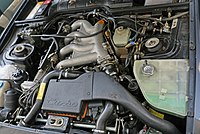
The M44/51 turbocharged Inline-4 engine
For the 1986 model year, Porsche introduced the 944 Turbo, known internally every bit the 951. The Turbo had a turbocharged and intercooled version of the standard 944's engine that generated 220 PS (162 kW) (217 hp (162 kW) in the US) at 6,000 rpm. In 1987, Machine and Driver tested the 944 Turbo and achieved a 0–97 km/h (0–60 mph) time of 5.9 seconds. The Turbo was the first Porsche production auto utilising a ceramic port liner to retain exhaust gas temperature along with new forged pistons and was besides the beginning vehicle to produce an identical ability output with or without a catalytic converter. The Turbo likewise featured several other changes, such as improved aerodynamics, notably an integrated front bumper. This featured the widest turn signals (indicators) fitted to whatsoever production car, a strengthened gearbox with a dissimilar final drive ratio, standard external oil coolers for both the engine and manual, standard sixteen inch wheels (optional forged Fuchs wheels), and a slightly stiffer suspension (progressive springs) to handle the extra weight. The Turbo's front and rear brakes were borrowed from the 911, with Brembo 4-piston stock-still calipers and 12-inch discs. Engine component revisions, more than thirty in all, were fabricated to the 951 to recoup for increased internal loads and oestrus.[10]

1987 Porsche 944 Turbo (The states model)
Changes occurred for the 1987 model year. Interior wise, the North American variant of the 1987 944 Turbo became the outset production car in the world to be equipped with driver and passenger side air bags every bit standard equipment. A low oil level light was added to the nuance also as a 180 mph (290 km/h) speedometer equally opposed to the 170 mph (270 km/h) speedometer on the 1986 model year cars. Also included was the deletion of the manual oil libation, and a change in suspension control artillery to reduce the car'due south scrub radius. The engine remained the same M44/51 inline-4 as in the 1986 model. Similar the standard 944, ABS at present became an available option.
In 1988, Porsche introduced the 944 Turbo Due south with a more powerful engine (designation number M44/52) rated at a maximum power output of 250 PS (184 kW) at vi,000 rpm and 350 Northward⋅m (258 lb⋅ft) of torque at 4,000 rpm (the engine in the standard 944 Turbo generated 223 PS (164 kW) and 243 lb⋅ft (329 N⋅m)). This higher output was achieved past using a larger KKK K26-8 turbocharger housing and revised engine mapping which allowed maintaining maximum boost until 5,800 rpm, compared to the standard 944 Turbo, the boost would decrease from 0.75 bar (10.9 psi) at three,000 rpm to 0.52 bar (seven.five psi) at 5,800 rpm. In June 1988, Car and Driver tested the 944 Turbo South (with the advantage of shorter final bulldoze gear) and achieved a 0–97 km/h (0–sixty mph) acceleration time of five.5 seconds and a quarter-mile time of 13.ix seconds at 163 km/h (101 mph). Top speed was factory rated at 261 km/h (162 mph).
The 944 Turbo S' suspension had the "M030" option consisting of Koni adjustable shocks at the front and rear, with ride acme adjusting threaded collars on the front struts, progressive rate springs, larger hollow rear anti-roll/torsion bars, harder durometer intermission bushings, larger 26.8 mm (1.055 in) hollow anti-roll/torsion bars at the front, and chassis stiffening brackets in the front frame track. The air conditioning dryer lines were routed and then as to articulate the front end frame caryatid on the driver's side. The 944 Turbo S wheels, known as the Club Sport design, were sixteen-inch Fuchs forged and flat-dished, similar to the Design 90 wheel. Wheel widths were 7 inches (178 mm) at the front, and 9 inches (229 mm) at the rear with a 52 mm (two.047 in) offset; sizes of the Z-rated tyres were 225/50 in the forepart and 245/45 in the rear. The front and rear fender edges were rolled to accommodate the larger wheels. The manual transmission (case code designation: AOR) featured a higher friction clutch disc setup, an external cooler, and a limited-slip differential with a 40% lockup setting. The Turbo Southward' forepart brakes were borrowed from the 928 S4, with larger Brembo GT 4-piston stock-still calipers and 12-inch discs; rear Brembo brakes remained the aforementioned as a standard Turbo. ABS likewise came standard.[11] [12]
The 944 Turbo S' interior featured power seats for both driver and passenger, where the majority of the factory-built Turbo Southward models sported a "Burgundy plaid" (Argent Rose edition) interior colour but other interior/outside colours were available. A 10-speaker sound system and equalizer + amp was a common choice with the Turbo Southward and S/SE prototypes. Simply the earlier 1986, 253 PS (186 kW) prototypes featured a "special wishes custom interior" options parcel.[13]
In 1989 and later production years, the 'South' designation was dropped from the 944 Turbo S, and all of the turbocharged iterations of the 944 featured the Turbo Due south enhancements as standard, however the "M030" suspension and the Society Sport wheels were not role of that standard.[14] The 944 Turbo S was the fastest production four cylinder car of its time.[fifteen]
944 Southward [edit]

1987–1988 Porsche 944S, with the sixteen-valve DOHC engine (this example is equipped with five-spoke wheels used on the 964)
For the 1987 model year, the 944 Southward (the S beingness the abbreviation of Southwarduper) was introduced. The 944 Southward featured a high performance naturally aspirated, dual-overhead-cam 16-valve 190 PS (140 kW; 187 hp) version of the 2.5 Fifty engine (M44/twoscore) featuring a self-adjusting timing belt tensioner. This marked the outset utilise of four-valves-per-cylinder heads and DOHC in the 944, derived from the 928 S4 featuring a redesigned camshaft drive, a magnesium intake tract/passages, magnesium valve cover, larger chapters oil sump, and revised exhaust system. The alternator capacity was 115 amps. The wheel bearings were also strengthened and the brake servo action was fabricated more powerful. Floating 944 calipers were standard, only the rear wheel brake circuit pressure regulator from the 944 turbo was used. Small-scale 'sixteen Ventiler' script badges were added on the sides in forepart of the body protection mouldings. Performance figures included 0-100 km/h (62 mph) being achieved in 6.5 seconds (All-time) and a 232 km/h (144 mph) top speed due to a 1,296 kg (2,857 lb) curb weight. It too featured an improved programmed Bosch Digital Motronic ii Estimator/DME with dual knock sensors for improved fuel performance for the higher 10.ix:1 compression ratio cylinder head. Like the 944 Turbo, the 944 South received progressive springs for improved treatment, larger front end and rear anti-roll bars, revised transmission and gearing to ameliorate accommodate the 2.5 L DOHC engine's higher six,800 rpm rev limit. Dual safe air bags, express-slip differential, and ABS braking system were optional on the 944 S.
A Lodge Sport touring package (M637) was available every bit was the lightweight 16-inch CS/Sport Fuchs 16x7 and 16x9 forged alloy wheels. This version was raced in Canada, Europe and in the IMSA Firehawk Cup Series held in the U.S. Production was simply during 1987 and 1988. It was superseded in 1989 by the 'S2' version. The 1987 944 Due south' ability-to-weight ratio was such that it was able to accelerate from 0 to 100 km/h in 6.5 seconds thus matching the acceleration of its newer larger displacement 3.0 L 944 S2 sibling.
944 S2 [edit]
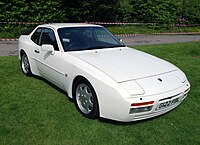

In 1989 the 944 S2 was introduced, powered by a 211 PS (155 kW; 208 hp) naturally aspirated, dual-overhead-cam xvi-valve 3.0 L version of the 944 South' engine. With a bore of 104 mm (4.1 in) and a stroke of 88 mm (iii.5 in), it was the largest production 4-cylinder engine of its time.[xvi] The 944 S2 likewise received a revised manual and gearing to amend conform the three.0 L M44/41 powerplant. The 944 S2 had the same rounded nose and a rear valance found on the Turbo model. Quoted performance figures included a 0–97 km/h acceleration time of 6.0 seconds (0–100 km/h beingness accomplished in 6.eight seconds) and a top speed of 240 km/h (150 mph) for the cars with a manual transmission. A Club Sport touring packet (M637) was also bachelor. Dual air numberless (left hand drive models), limited-slip differential and ABS were optional. Design xc 16-inch cast alloy wheels were standard equipment.[17]

944 S2 Cabriolet [edit]
In 1989, Porsche introduced the 944 S2 Cabriolet, the first 944 to feature a convertible trunk style. The contract to build Porsche's 944 S2 Cabriolet was awarded to ASC (American Sunroof Visitor) in Weinsberg, Germany. The S2 Cabriolet was a very complicated build, where 944 coupe bodies were taken off the assembly line at Neckarsulm, Deutschland and then delivered to ASC in Weinsberg, Germany. At ASC, reinforcement plates are welded in the front terminate of the auto and flooring plate area to give the body the amount of torsional strength and crash safety required for the convertible. After welding in these reinforcement plates, cuts are fabricated in the body at the windshield frame, B pillars, rear side panels and tail panel, in preparation for coupe acme removal. New parts to back up the convertible top and the new rear deck chapeau are also welded in place. Then the new Cabriolet trunk was sent back to Neckarsulm, where it is run through the standard production paint shop and assembly line for drive railroad train install. Consequently the structure of the pigment stop and other corrosion inhibiting measures arrange with the quality standards for Porsche and its new Cabriolet. The assembled Cabriolet was then sent back to ASC in Weinsberg for convertible height and trim installation. With production not starting until May of 1989, simply 16 of the 944 S2 Cabriolets were produced for the U.Due south. marketplace. For the 1990 model year, Porsche produced 3,938 cars for all markets including correct-hand drive units for the United Kingdom, Australia and South Africa. The share for the U.S. market in 1990 increased to 1824 units and followed with 561 units for 1991, which was the terminal year of production for the 944 S2 Cabriolet.
944 Turbo Cabriolet [edit]

Porsche 944 Turbo Cabriolet
In Feb 1991, Porsche unveiled the 944 Turbo Cabriolet, which combined the Turbo Southward' 250 PS (184 kW) engine with the cabriolet trunk style as well built by ASC. Porsche initially announced that 600 cars would exist made; ultimately 625 were built, 100 of which were correct-hand drive for the United kingdom, Japanese, Australian, and Due south African markets. None were imported to the U.Due south. and The Americas.[18]
End of production [edit]
In early 1990, Porsche engineers began working on what they had intended to be the 3rd evolution of the 944, the S3. As they progressed with the development process, they realised that so many parts were being changed that they had produced an almost entirely new vehicle. Porsche consequently shifted development from the 944 Southward/S2 to the car that would replace the 944 entirely, the 968. The 944's final yr of production was 1991 with over 4,000 cars built and sold. In 1992, the 968 debuted and was sold aslope the 928 until 1995, when both water-cooled front engine models were discontinued without a straight successor.[xix] [20]
In February 1992, a verbal agreement was given to Porsche UK from Stuttgart for the production of a prototype "Sports Equipment" 944 S2 Model with following approval to construct 15 vehicles for the UK market place from the last 944 S2 coupés produced. A unique 30mm lower fully adjustable Koni Intermission with springs from the Turbo was used in combination with upgraded 31mm front end stabiliser bar & adjustable rear bar. Engine output was increased to 225 PS (165 kW) with re-map to improve torque above iv,250rpm, too as a unique sports frazzle system. Cosmetically the "SE" was fitted with Porsche color matched "Porsche Sport" steering wheel, Bi-plane rear spoiler, SE side decals and rear badging. The modifications resulted in improved acceleration in higher rev range, flatter cornering, more precise steering, improved responsiveness, conviction inspiring handling leading to an overall sharper response. The 944 S2 SE prototypes are regarded as the inspiration and in part development for the later 968 Club Sport.[21]
Production [edit]
A grand total 163,192 cars in the 944 family unit were produced betwixt 1982 and 1991. This made it the most successful sports motorcar in Porsche's history until the introduction of the Boxster/Cayman and 997 Carrera.
The successor to the 944 was the 968, which was introduced in the 1992 model twelvemonth and was based on an development of the same front-engine, transaxle platform of the 944.
944 [edit]
A total of 113,070 944s were fabricated between 1982 and 1989, with 56,921 beingness exported to the The states. A projection joint venture with Porsche and Callaway resulted in xx specially built turbo 944's built for the US market in 1983.[22]
| Model Yr | Product | World Markets | US | Notes |
|---|---|---|---|---|
| 1982 | 3,921 | three,921 | ||
| 1983 | 14,633* | 9,127 | five,490 | 20 Callaway 944 Turbo cars |
| 1984 | 26,539 | 9,921 | sixteen,618 | |
| 1985 | 23,720 | 17,553 | half-dozen,167 | |
| 1986 | 17,010 | 6,109 | 10,901 | |
| 1987 | 10,689 | 2,343 | 8,346 | |
| 1988 | v,965 | two,226 | three,731 | 8 exported to Australia |
| 1989 | ten,593 | iv,941 | 5,652 | 2.7 L Engine |
| Thou Full | 113,070 | 56,141 | 56,921 |
944 Turbo (951/952) [edit]
A total of 25,245 944 Turbos were made, with 13,982 being exported to the United States.
| Model Twelvemonth | Production | World Markets | US | Notes |
|---|---|---|---|---|
| 1985 | 178 | 178 | ||
| 1986 | 10,937* | three,424 | 7,513 | 12 S/SE Prototypes, viii LHD (951), 4 RHD (952) |
| 1987 | 4,955 | one,546 + 88 Turbo CUP cars | three,210 + 11 Turbo Cup cars | |
| 1988 | 4,097 ** | 1,875 + 94 Cup | 1,874 + 99 Cup | in addition, 126 SP Canadian marketplace cars, 30 Australian Turbo CUP cars |
| 1989 | 4,103 | i,333 | i,385 | ane,385 Canadian market cars |
| 1990 | 1251 | 1107 | 144 | 44 Canadian market cars |
| 1991 | 938 † | 938 | ||
| Thousand Total | 25,245 | 9,331 | thirteen,982 | 30 Australian market cars 1,511 Canadian market cars |
* - Includes 12 Turbo S (951) / SE in UK (952), factory built prototypes of which x were exported to markets exterior Germany.
** - Includes 1635 Turbo S
† - Includes 251 Turbo Cabriolet. A dissimilar source, Jerry Sloniger'due south article in the Oct 1991 consequence of Excellence, indicates that the manufacturing plant built 525, of which 255 were exported to markets outside Federal republic of germany.
< >"Cup" designates a cup car which is a special edition race motorcar.
944 S [edit]
A total of 12,936 944 South models were produced from 1987 to 1988, with viii,815 being exported to the United states. In 1985 a Prototype 944 Due south Cabriolet 'Studie' built by Braun was powered by the ii.5 L xvi valve which developed 185 hp, precursor of the later production 944 Southward and S2 Cabriolet models.[ citation needed ]
| Model Year | Production | World Markets | Usa | Notes |
|---|---|---|---|---|
| 1987 | 5,224* | ane,912 | 3,312 | 75 CS/Club Sport & Loving cup Cars |
| 1988 | 7,562* | 2,321 | 5,391 | 75 CS/Club Sport & Cup Cars |
| Special Editions | 151 | 38 | 112 | 1 1985 "Studie" Cabriolet Prototype (Braun) |
| M Total | 12,936 | four,271 | 8,815 |
* - Includes CS - Guild Sport's built for US, and ROW markets.
944 S2 [edit]
A total of effectually 14,071 944 S2'south were made between 1989 and 1991, with iii,650 being exported to the United States.
| Model Yr | Production | Globe Markets | US | Notes |
|---|---|---|---|---|
| 1989 | seven,632 | 4,941 | 2,691 | 51 Australian market cars |
| 1990 | 3,321 | 2,872 | 449 | 71 Australian market cars |
| 1991 | three,118 | 2,608 | 510 | vi Australian marketplace cars |
| Grand Total | 14,071 | 10,421 | 3,650 |
944 S2 Cabriolet [edit]
Production of the 944 S2 Cabriolet began in May of 1989, simply official total production numbers for that first year and globe market production are non well established. The but product number listed for 944 S2 Cabriolets in 1989, are the 16 produced for the US market. Although at that place are several 1989 944 S2 Cabriolets still registered in the US, in that location is speculation that the original xvi produced for the U.s. market in 1989 were initially not intended to exist sold to the public. There are more than a few 1989 built/manufactured 944 S2 Cabriolets registered in the UK and Germany, both left and right hand drive. It is presumed that much of the world production for 1989 and 1990 stayed in Germany and the U.k..
Full production for years 1990 and 1991 are well documented, besides as the three twelvemonth total production for the US market place of 2,402 units.
| Model Year | Production | Globe Markets | US | Notes |
|---|---|---|---|---|
| 1989 | N/A | N/A | sixteen | Vin numbers for 1989 US market begin WPOBA, 16 cars simply. |
| 1990 | 3,938 | two,114 | 1,824 | Vin numbers for 1990/1991 Us market begin WPOCB. |
| 1991 | 1,702 | 1,140 | 562 | Last year of product. |
| Grand Total | 5,656 | 3,254 | two,402 |
Motorsport [edit]
SCCA Product Class and Trans Am [edit]
After numerous successes in Europe by both the Porsche factory squad and privateers at Le Mans and various supporting races, the 924/944 platform was and then introduced with relative success over in North America under the SCCA Production Form. In 1986, the Carlsen Racing 944 won the SCCA Escort Endurance Serial Championship (S/S GT).[23] The 1988 and 1989 SCCA GT2 titles were claimed the 944S driven by David Finch for the years 1988 and 1989.[23] Heavily modified versions of the 944, some with a tube framed chassis that were congenital by Klym Fabcar in North America were run in the SCCA Trans Am title, Initially these cars were run with the Audi sourced 2.0 litre engine but were dropped in favour of the Porsche 2.five litre which was and so tuned and upgraded to have an output of upward to 750bhp by a visitor called ANDIAL[3]
944 Turbo Cup [edit]


Porsche began a race series for the summit-of-the line 944 Turbo in the mid-1980s. There were five championship series: i in French republic, one in Germany, one in South Africa, one in Canada, and one in the United States. Each had a different number of cars competing. The Turbo Cup cars developed for the series had substantial upgrades over their road going counterparts. These included a larger KKK K26-8 turbocharger, a magnesium intake manifold and oil pan, a reinforced transmission, clutch, differential and axles along with removal of A/C, power seats, leather upholstery, sun visors, power windows, power steering, rear wiper, headlight washers, fender liners, storage pockets, and rear trunk release, upgraded struts, shocks, springs, intermission mounts, as well every bit an adaptable ABS system, bigger brakes with racing pads, magnesium wheels, a transmission oil cooler, and a lightweight bombardment. This yielded weight savings of approximately 272 kg (600 lb) and improvements in performance of the car as the Turbo Cup cars had a 0–97 km/h (60 mph) acceleration time of 5.iii seconds and a top speed of almost 274 km/h (170 mph). 192 Turbo Cup cars were made of which 99 cars for Canada, VIN start WP0AAO and 93 for the rest of the globe, VIN start WP0ZZZ. Cup cars are identified having the last four VIN digits from 1501 to 1700[24] [25]
Awards [edit]
The 944 was on Car and Driver's X Best listing from 1983 through 1985, and the Turbo fabricated the list for 1986.
In 1984, Car and Driver named the 944 the Best Handling Production Car in America.
Run across also [edit]
- 944 Loving cup
References [edit]
Notes [edit]
- ^ Ludwigsen, Karl E. (2008). Porsche, Excellence was Expected (Second ed.). Bentley Publishers. ISBN9780837602356.
- ^ "Which famous sports car is hidden below this Opel Manta torso?". Classic Driver. fifteen January 2022. Retrieved three May 2022.
- ^ a b Smith, Roy (2014). The Porsche 924 Carrera. Veloce Publishing Limited.
- ^ Long, Brian (2008). Porsche Racing Cars: 1976 to 2005. Veloca Publishing Express.
- ^ "1981 Porsche 924 GTP: The 944 prototype debuted at Le Mans in 1981". autoweek.com. 20 August 2000. Retrieved eighteen July 2022.
- ^ a b c Levy, George D. (iii May 1982). "Le pur sang Porsche". Autoweek. Vol. 32, no. 18. Crain Printing Inc. p. 11. ISSN 0192-9674.
- ^ Mazlumian, Pablo (two September 2003). "Projection Porsche 951 1986 944T Specifcations [sic]". superstreetonline.com . Retrieved 29 May 2022.
- ^ "1983 Porsche 944". Classic Driver (in German). Archived from the original on 24 May 2022. Retrieved 29 May 2022.
- ^ "Callaway Porsche 944". Retrieved 18 July 2022.
- ^ "Road test - Porsche 944 Turbo- Stuttgard Slingshot". Motor Sport. May 1986. Retrieved 28 Oct 2022.
- ^ Silvestro, Brian (6 February 2022). "The Porsche 944 Turbo S Is a Lot More Than But a Badge". Road & Track. Retrieved 28 October 2022.
- ^ ""Porsche 944 Turbo S" – Car and Driver, 1988". 944.net . Retrieved 28 October 2022.
- ^ "Porsche 944 - Porsche AG". Porsche AG - Dr. Ing. h.c. F. Porsche AG . Retrieved ix January 2022.
- ^ Milani, Jon. "944 Turbo Southward: Overview". Porsche 944 Turbo Resource . Retrieved 29 May 2022.
- ^ "Porsche 944 Turbo (951/952) History". deutschnine.com. Archived from the original on 23 February 2022. Retrieved 29 May 2022.
- ^ "Introduction to the Porsche 944 S2". deutschnine.com. Archived from the original on 6 May 2022. Retrieved 29 May 2022.
- ^ "Porsche 924 944 and 968 History". How Stuff Works . Retrieved three May 2022.
- ^ "Porsche 944 Turbo Cabriolet". Retrieved 17 July 2022.
- ^ "Porsche 968 (1992 - 1995) used car review". RAC. nineteen June 2007. Retrieved 3 May 2022.
- ^ Ramsey, Jonathon (30 June 2022). "The dream of the '90s is alive in Porsche 968 retro review". Autoblog. Retrieved iii May 2022.
- ^ "1092 Porsche 944 S2 SE Coupé". Bonhams. 9 September 2022. Retrieved 3 May 2022.
- ^ Murilee Martin (10 December 2008). "Prissy Price or Crevice Pipe: The $45,000 Callaway Porsche 944?". Jalopnik. Retrieved eighteen July 2022.
- ^ a b Long, Brian (2001). Porsche 944. Veloce Publishing Limited.
- ^ Silvestro, Brian (12 September 2022). "Someone Please Take This Never-Raced 944 Turbo Cup Car to the Rails". Route & Rails. Retrieved 28 October 2022.
- ^ Gushue, Ted (14 April 2022). "This 944 Turbo Cup Car Is Provenance Preserved". Petroliciois. Retrieved 28 Oct 2022.
Bibliography [edit]
General [edit]
- Austen, Jörg (2013). Porsche 924 / 944, 968 (in German). Stuttgart: Motorbuch Verlag. ISBN9783613034990.
- Bongers, Marc (2006). Porsche Information Volume: The definitive reference to specifications and statistics. Sparkford, Somerset, UK: Haynes Publishing. ISBN1844253163.
- Clarke, R.M., ed. (1985). Porsche 944: 1981-1985. Road Test Series. Cobham, Surrey, U.k.: Brooklands Books. ISBN0948207264.
- ——————, ed. (1994). Porsche 944 Aureate Portfolio 1981-1991. Route Test Portfolio Series. Cobham, Surrey, United kingdom of great britain and northern ireland: Brooklands Books. ISBN1855202352.
- ——————, ed. (2001). Porsche 944 Ultimate Portfolio. Road Test Portfolio Series. Cobham, Surrey, United kingdom of great britain and northern ireland: Brooklands Books. ISBN1855205602.
- Cotton, Michael (2000). Porsche 924, 944 & 968: A Collector's Guide (rev. and expanded ed.). Croydon, United kingdom: Motor Racing Publications. ISBN1899870474.
- Cranswick, Marc (2008). Porsche 928, 924, 944 and 968: The Front-Engined Sports Cars. Jefferson, NC, United states: McFarland & Company. ISBN978-0-7864-3040-6.
- Edwards, Nigel (1992). Porsche 924 & 944: color, information and detail on the iv-cylinder front-engined cars including 968. Classics in Colour, no. i. London: Windrow & Greene Automotive. ISBN1872004768.
- Fuths, Thomas (2020). Porsche 924 944 968 928. Bewegte Zeiten serial (in German language). Bielefeld, Germany: Delius Klasing. ISBN9783667118356.
- Higgins, Andrew; Mitchell, Jon (2020). Porsche 944: All models 1982 to 1991. The Essential Heir-apparent's Guide series. Dorchester, Dorset, United kingdom: Veloce Publishing. ISBN9781787116610.
- Long, Brian (2017). Porsche 944. Veloce Classic Reprint Serial. Dorchester, Dorset, United kingdom of great britain and northern ireland: Veloce Publishing. ISBN9781787111356.
- Ludvigsen, Karl (2019). Porsche: Excellence Was Expected. Vol. Book iii: Comeback (1982-2008) (All new ed.). Cambridge, MA, United states: Bentley Publishers. ISBN9780837617725.
- MacNamara, Julian (1984). Porsche 944. Loftier Performance Series. New York: Arco Publishing Company. ISBN0668061464.
- Morgan, Peter (1990). The Porsche 924/944 Book. Foulis Motoring Volume serial. Sparkford, Somerset, England; Newbury Park, CA, USA: Haynes Publishing. ISBN0854297642.
- —————— (1998). Original Porsche 924/944/968: The Guide to all models 1975-95, including Turbos and limited edition. Bedford, Devon, UK: Bay View Books / Osceola, WI, USA: Motorbooks. ISBN190143205X.
- —————— (2009). Porsche 944 and 968 (1981-1995). Ultimate Buyers' Guide (2d ed.). Marlborough, Wiltshire, UK: PMM Books. ISBN9781906712075.
- Muche, Jan-Henrik (2002). Porsche 924 & 944: Mit vier Zylindern zum Erfolg [Porsche 924 & 944: With Four Cylinders to Success]. Edition Oldtimer-Markt series (in German). Königswinter, Frg: Heel Verlag. ISBN3898801055.
- Pitt, Colin, ed. (2006). Porsche 924 · 944 · 968. Hockley, Essex, Uk: Unique Motor Books. ISBNane-84155-365-4.
- Schrader, Halwart (2018). Porsche 924/944/968 (in High german). Stuttgart: Motorbuch Verlag. ISBN9783613041271.
- Sloniger, Jerry (1987). Porsche 924 928 944 (2nd ed.). London: Osprey Publishing. ISBN0-85045-776-ix.
- Smale, Glen (2015). Porsche 924/928/944/968: The Consummate Story. Crowood AutoClassic Series. Ramsbury, Marlborough, Uk: The Crowood Press. ISBN978-one-78500-039-3.
- Stuever, Hank. "Existent Men Deceit Hold a Match to Jake Ryan of 'Sixteen Candles.' Washington Post, Feb 14, 2004
- Vivian, David (1993). Porsche 924·928·944·968. Crowood AutoClassic Serial. Ramsbury, Marlborough, UK: The Crowood Press. ISBNone-85223-483-0.
- Weber, Louis (2000). Porsche: The Essence of Functioning. Lincolnwood, IL, USA: Publications International. ISBN078533498X.
- Wood, Jonathan (1997). Porsche: The Fable. Bath, Great britain: Parragon Books. ISBN1405426934.
- Automobile, September 1987 Issue
- Auto and Commuter, Dec. 1985 Issue
Workshop manuals [edit]
- Warren, Larry; Muir, Chaun; Haynes, John H. (1997). Porsche 944: 1983 thru 1989, All SOHC engine models. Haynes Service and Repair Manual Serial. Sparkford, UK; Newbury Park, CA, The states: Haynes. ISBN1850106576.
- Porsche 944 2.5i- und iii.0i-Liter-16V-Motor ab Juni 1981. Reparaturanleitung series, Band 1140. (in German). Zug, Switzerland: Verlag Bucheli. 2003. ISBN9783716817766.
External links [edit]
- Porsche 944 Turbo Historical Resource
- Porsche 944 Turbo Resource
- Porsche 944 Repair and Upgrades
- Porsche 944 Repair Guides
- Porsche 944 Turbo
- Porsche 944 Turbo Cabriolet Registry

Source: https://en.wikipedia.org/wiki/Porsche_944
Posted by: toppagne1998.blogspot.com
0 Response to "How To Repair Porsche 944 S2 Cabriolet Top"
Post a Comment